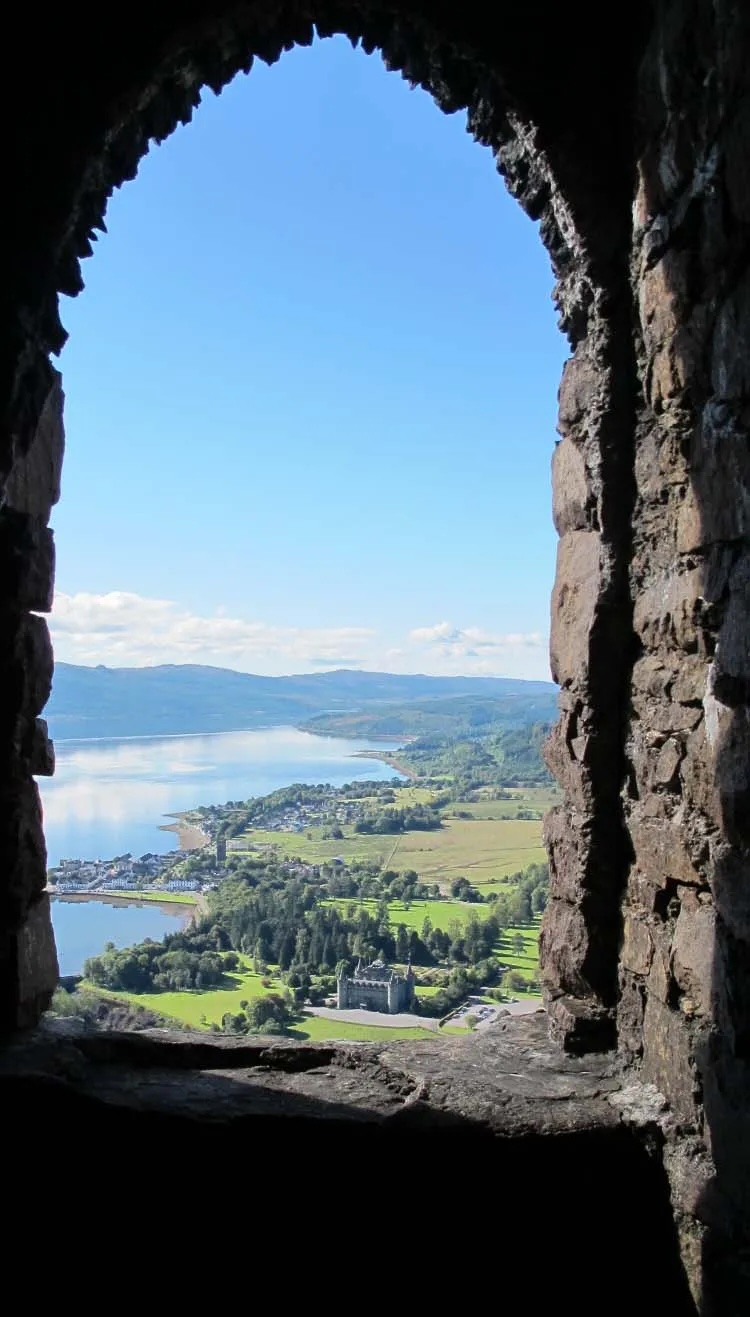
If a landscape ‘speaks’, can we hear it?
A member responds to Professor Aonghus Mackechnie’s thought-provoking lecture to the AHSS Forth and Borders Group and Scotland’s Garden and Landscape Heritage.
On Monday 10 November 2025 Professor Aonghus Mackechnie gave a thought-provoking lecture to the AHSS Forth and Borders Group and Scotland’s Garden and Landscape Heritage. His title was ‘If a landscape ‘speaks’, can we hear it?’ His lecture took his audience from the medieval West Highlands and Gaelic society, through Early Modern Scotland, the exploitation of history and the ‘signage’ used by the Stewart monarchy, through to post-1660s classicism; moving then on to the Ages of Romanticism and Improvement, and that of militarism after the Battle of Sheriffmuir in 1715.
His paper highlighted how natural features had been brought into service as early medieval political boundaries, using Gaelic placenames to support his argument; moving on to consider landscapes which partnered with built structures, considering the different meanings such landscapes might have for different communities or individuals.
Regarding the Jacobite era, for instance, a building such as Inveraray Castle, in its Sublime setting, might have a vital place in the early history of Romanticism, with its dive into the past to imply re-living the times of a laird, nurturing the nascent fashion for the neo-chivalric. But its castellated form, signalling aggression and control, might have been difficult for a vanquished Jacobite to face; while precisely these aspects could be simultaneously a comfort to the anti-Jacobite. Such meanings, strong once, might be lost over time. Or the opposite might happen at given locations – where new, or perhaps counter-meanings might arise as time passes.
A member responded:
‘On my journey home, I asked myself about landscapes which spoke to me. The first which came to mind was that represented by the Calton Hill. The great Royal High School (RHS) building is a monument to the historic pre-eminence of Scottish education. The RHS was run in tandem with Edinburgh University famed, throughout the world, for its teaching of medicine.
Edinburgh was an Enlightenment capital within Europe – unmatched by any centre in England. It attracted great minds and many visitors who, towards the end of the 18th century, helped convey the magic of its landscape. Ideas of Scotland, the land of Ossian, won the hearts of Romantic Europe (including Napoleon).
After the Union of the Parliaments, able Scots headed south to take advantage of the greater opportunities afforded by the bigger market there. There was such an influx of well-educated individuals that by the 1760s the fear was that the Scots were taking all the best jobs – some sort of reverse take-over. We may, these days, be embarrassed by Britain’s colonial past but Scottish education and drive will have been key to that. The Darien Scheme may have been a failure but it showed Presbyterian interest in commerce and proselytization.
I have no great difficulty in seeing and acknowledging the horrors related to the ’45 and Hanoverian excess. A substantial part of our heritage was laid waste – as the building and artifacts of the Catholic religion had been destroyed by an earlier generation of “driven” Scottish zealots. I had not noticed, until yesterday evening, the aggressivity of the Tay Bridge at Aberfeldy and other constructions – but might wonder what our speaker would have suggested as suitable alternative forms of decoration. It would be another half century before Schiller wrote of all men becoming brothers and Burns “A man’s a man……”
One of the things which has long intrigued me is the late 18th and early 19th century development of the castle style. In Adam’s early castle style, the idea was of a folly, perhaps linked to a family with a particular history. However, in the wake of the French Revolution the castle concept would reinforce class division, reminding many that those within the castle walls were almost certainly invested with the means of remaining in control. What is interesting is that this castle phenomenon was across the whole UK and not an English reminder to the Scots.
We may forget the extent of the fear of Revolution in the UK in the 1790s – but we then return to the Calton Hall where amongst the monuments to our intellectual greats there is the so-called Martyr’s Monument… We may forget also that prior to the French Revolution the French Royal Family were protected by two crack divisions of guards, the Swiss – and the Scottish.
If some can suggest that Scotland was sold to England for thirty pieces of silver, I would respond by saying that many countries and nations in Europe over the last 400 years did not even receive thirty pieces of silver. Louis XIV gave his country more or less its present borders by conquest in the last quarter of the 17th century. Napoleon came along and mixed it up a bit across Europe creating new kingdoms etc and then that was all further re-organised through the Congress of Vienna. One of longest suffering of European countries has been Poland – constantly in the sights variously of Russia, Prussia, Austria and Germany.
A brief war between Prussia and Austria in 1866 led to the absorption by Prussia of the kingdom of Hanover while Bavaria, hitherto the great power in the German Confederation, was sacked and obliged to pay reparations for having supported the wrong side.
Thus it continued with (a) the former Duchy of Savoy being re-shaped as part of the movement for the establishment of an Italian kingdom – with France recompensed with Nice and a chunk of Riviera coastline for its support and (b) the German Empire’s temporary recovery of the by then French provinces of Alsace and Lorraine.
It is almost 300 hundred years since the ’45. Scotland has since then been spared the territorial conflicts which have beset most other nations. If the Romantic thinks of Mary Queen of Scots and Bonnie Prince Charlie it is because that there has been nothing of that ilk in the last near 300 years.’
Do other members have suggestions about landscapes that ‘speak’ to them?