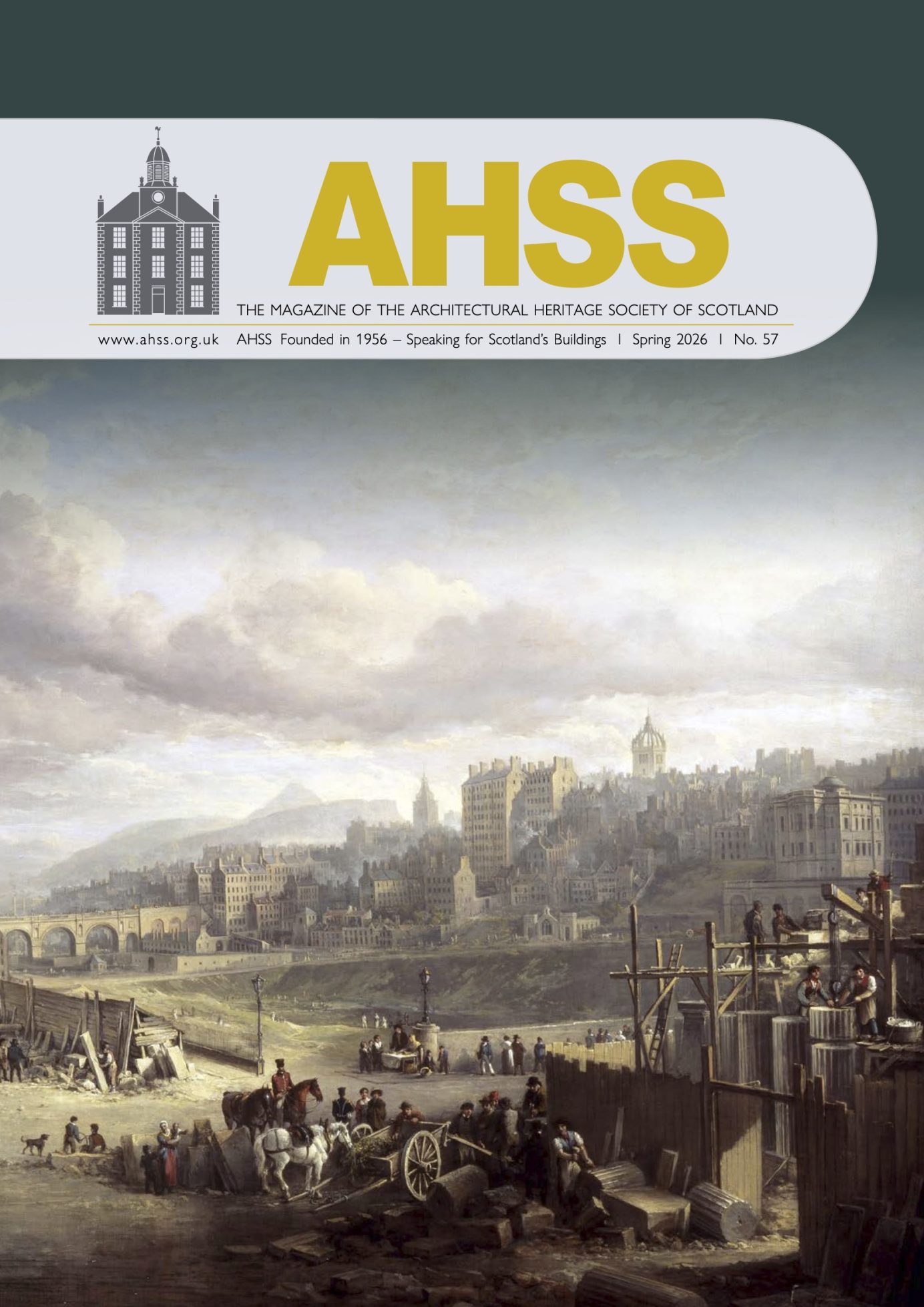
Spring 2026 Magazine
Celebrating 200 years of the Royal Scottish Academy, this issue examines architecture, conservation, traditional skills and the challenges facing Scotland’s historic environment today.
This year marks the bicentenary of the Royal Scottish Academy’s foundation and its home, the Royal Institution, designed by William Playfair. Alexander Nasmyth’s 1825 painting, featured on the magazine’s cover, captures him (if you look closely) and a moment in its construction. Playfair was beset by difficulties in sourcing suitable stone to complete the project, and researcher Samantha Carrie examines his search.
The RSA’s formation, supported by Thomas Hamilton, reflected a desire to unite the arts and architecture within a single institution. Robbie Macfarlane highlights the Academy’s architect presidents, their considerable achievements and challenges.
Sadly, the fire safety of historic buildings is, once again, in the news. Our next feature, by Benjamin Tindall and Amy Aquilina, shows how a creative approach can mitigate risks while respecting the fabric of important historic sites.
Dr William Napier analyses the statistics and policies behind the sector’s skills deficits, revealing a concerning and growing gap between workforce capacity and demand. Next, stone carver Neil Paterson describes the hands-on workshops he’s run for young people to encourage a new generation to get involved.
Our Spotlight feature turns to Edinburgh’s missing ‘Trinity Stones’, with Jill Harrison leading the search. Trinity Collegiate Church, demolished to make way for Waverley Station, was only partially reconstructed at Chalmers Close, and much remains unaccounted for. Perhaps readers can help?
The May parliamentary elections prompted several organisations to publish ‘manifestos’, which Martin Robertson reviews through an AHSS lens. To paraphrase: great ideas, but is anyone listening?
Book reviews range across periods and places: modern and modernist buildings, a survey of Scottish architecture from its earliest forms, and reflections on how these places shape our identities.
Our usual Historic Environment Scotland designations and archives reports are joined by one from the Scottish Historic Buildings Trust in which director, Dr Samuel Gallacher, announces its new strategy.
Casework reports illustrate some common frustrations. Great buildings languish; persistent, well- funded developers eventually get projects accepted; unsympathetic and ineffective energy-saving measures are waved through; retrospective applications for demolitions are approved; temporary structures become permanent. But in amongst the gloom, there are some successes, and, of course, the wonderful local group events programmes provide welcome respite, fun and inspiration.
Finally, RSA President Professor Gareth Fisher nominates his favourite building, describing it as containing “perhaps, the most beautiful modern spaces in the country”. Quite an accolade and a great example of how good architecture, whatever its age, can support vibrant, thriving communities.
Abigail Daly, Editor
AHSS Members can access the entire digital archive as part of their subscription.
Register here and then login in with your email and password.